A 6-week clinical course for driven, ambitious people who've done the books, the therapy, the work — and are still running the same patterns. Built on Judith Herman, MD's three-phase model — the recognized gold standard of trauma recovery.
Open to anyone, any gender, any gender expression.
Join the Waitlist · September Cohort
Read the books. Tried the therapy. Built the impressive life. And somewhere underneath all of it, the same patterns keep running. The same exhaustion. The same loop.
Because understanding your patterns isn't the same as moving through the phases that actually change them. The foundation was never repaired — and that's not your failure. It's the work that's still waiting.
If four or more of these resonate, you're exactly who this course was built for.
Six weeks of clinically sequenced work. Specific shifts, not vague promises.
Built on Judith Herman, MD's three-phase model of trauma recovery — the recognized gold standard, taught in trauma centers and graduate programs worldwide. Grounded in attachment theory, neurobiology, and relational psychology.
The order matters more than the content. You can't grieve what you haven't named. You can't reconnect until you've mourned. This course respects the architecture of how humans actually heal.
Video, audio, and full transcripts for every lesson. A 180+ page clinical workbook. Self-paced, returnable, lifetime access. This isn't a weekend intensive — it's a resource you'll come back to for years.
Most trauma programs online are built by coaches, content creators, or generalists. Fixing the Foundations was built by a licensed clinician with 15,000+ hours specializing in relational trauma recovery — and grounded in the same evidence-based framework Annie uses with her private clients.
| Weekly Therapy | Books & Podcasts | Trauma Coach Programs | Fixing the Foundations | |
|---|---|---|---|---|
| Led by | Licensed clinician | Author / host | Coach (unlicensed) | Licensed psychotherapist & relational trauma specialist · 15,000+ clinical hours · W.W. Norton author · Psychology Today contributor |
| Clinical framework | Yes | Varies | Often surface-level | Herman's three-phase model — gold standard of trauma recovery |
| Structured sequencing | Emergent | No | Topic-based | 7 phases, ordered |
| Workbook & exercises | No | Rare | Light worksheets | 180+ pages |
| Live access to clinician | 1:1 | No | Coach, not clinician | 12 live group sessions with Annie |
| Lifetime access | Per session | Yes | Often 1 year | Yes |
| Cost over 6 weeks | $4,050+ | $60 | $497–$2,000+ | $1,997 |
The somatic literacy to catch activation the moment it starts — and the tools to come back to yourself instead of performing, shutting down, or leaving. Not perfectly. But consistently enough that your body stops feeling like a place you have to manage.
The specific relational templates you inherited — named, traced, and visible. You'll catch the pattern in motion instead of waking up six months in wondering how you got here again.
The childhood you deserved, the parent you needed, the relationships that should have been safe — all of it processed in a structured clinical container instead of carried in silence. The heaviness in your chest lifts. You can think about your past without your nervous system seizing up. What you've been holding for twenty or thirty years stops being yours alone to hold.
Underneath the inner critic, the perfectionist, the people-pleaser, the over-functioner — there is a you who has been waiting to come forward. The survival beliefs that have been running your life — “I'm too much,” “Love always leaves,” “I have to earn it” — quiet down. The voice underneath them — steadier, clearer, more yours — gets louder. You stop performing who you think you need to be and start recognizing who you actually are.
The skills to say no without a 48-hour shame spiral. To have hard conversations without performing. To stay in conflict without it becoming catastrophe. Connection that doesn't require you to disappear.
Most driven, ambitious people spend decades building lives that look right and feel hollow. After six weeks, you'll know which parts of your life you were actually choosing — and which parts were assigned to you by a younger self trying to survive. You'll stop being a stranger inside your own days. The years ahead start to feel like yours to spend, not yours to endure.
Seven phases. Forty-nine lessons. Each one grounded in the clinical research that actually moves the needle on relational trauma — sequenced in the order the nervous system can metabolize them.
You're at dinner with someone you care about, and they say something that used to send you spiraling. This time, you notice the activation in your body — and you stay. You don't perform calm. You don't leave. You don't over-explain. You just stay present, because your nervous system actually knows it's safe.
You wake up on a Sunday and the first thing you feel isn't dread or the need to be productive. You feel settled. Not because everything is perfect — but because you're no longer bracing for the thing that always comes next.
Your mother calls. The voicemail sits in your inbox the way it always has. But this time you don't spend the rest of the afternoon writing imaginary responses in your head, replaying childhood, leaking into your evening. You feel what comes up, you put a hand on your chest, and you call her back when you're ready. Or you don't. Either is fine. The decision doesn't cost you a day.
You're in a meeting and someone challenges you. The old version of you would have over-prepared for a week, lain awake the night before, replayed it for three days after. This version notices the heat rise in your chest, takes a breath, and answers from somewhere steadier than the part of you that has always needed to be airtight. You sound like yourself. You leave the meeting without needing anyone's reassurance.
You say no to something and the world doesn't end. There's no 48-hour shame spiral, no drafting and redrafting the apology text, no quiet certainty that you've ruined the relationship. You said no because no was the right answer. The discomfort passes by Tuesday.
You're in your body in a way you haven't been in years. You notice you're hungry before you're shaking. You notice you're tired before you're crashing. You feel something pleasurable and you let yourself feel it for the whole length of it — not bracing for the shoe to drop, not narrating, not earning it first. You laugh and it surprises you a little, how easy it is.
The voice in your head sounds different. Less like a parent you couldn't please. More like someone who's been quietly on your side this whole time. You catch yourself being kind to yourself the way you've always been kind to your closest friend. It still surprises you sometimes. But it's the new default.
You look at your life and you recognize it as yours.
Not the one you built to survive. The one that finally feels good — lived by the version of you that was always there, before the trauma made you forget.
This is the year you'll stop over-functioning. This is the year you'll set the boundary with your mother. This is the year you'll stop performing. You wrote the same thing in your journal twelve months ago. You'll write it again next year. The patterns don't soften with time — they calcify. By 50, by 55, by 60, they're load-bearing walls.
You can quote van der Kolk. You've underlined Pete Walker. You know what hypervigilance is, what disenfranchised grief is, what your attachment style is — and you're still up at 3 AM rehearsing tomorrow's hard conversation. Insight without sequenced clinical work isn't healing. It's vocabulary. And vocabulary doesn't move the patterns.
The one who shuts down mid-conversation. The one who picks the fight to test whether they'll leave. The one who can't receive their love without flinching. They don't get the version of you who could be on the other side of this work next year. They get this version, for another decade. Sometimes they don't stay for it.
The unprocessed grief becomes the inheritance. The walking-on-eggshells, the over-functioning, the way you brace before answering — they're learning all of it before they can name it. You swore you wouldn't pass this down. Without the work, you will. Not because you don't love them. Because love wasn't enough to break it for the generation before you, either.
The jaw that won't unclench. The Sunday-night dread you've had since you were seven. The exhaustion that sleep doesn't touch. The stomach that knots before phone calls with certain people. The autoimmune flare that arrived the year of the hardest thing. The body keeps the score — Bessel van der Kolk wasn't being poetic. He was being clinical. The bill comes due.
Ready doesn't arrive on its own. It's built through the work. The version of you who feels ready is on the other side of the seven phases — not somewhere before them. Every year you wait for readiness is another year of the life organized around your wounds instead of around your wants. And one day, the math runs out.
This work is hard. But not doing it is harder. And it gets harder the longer you wait.
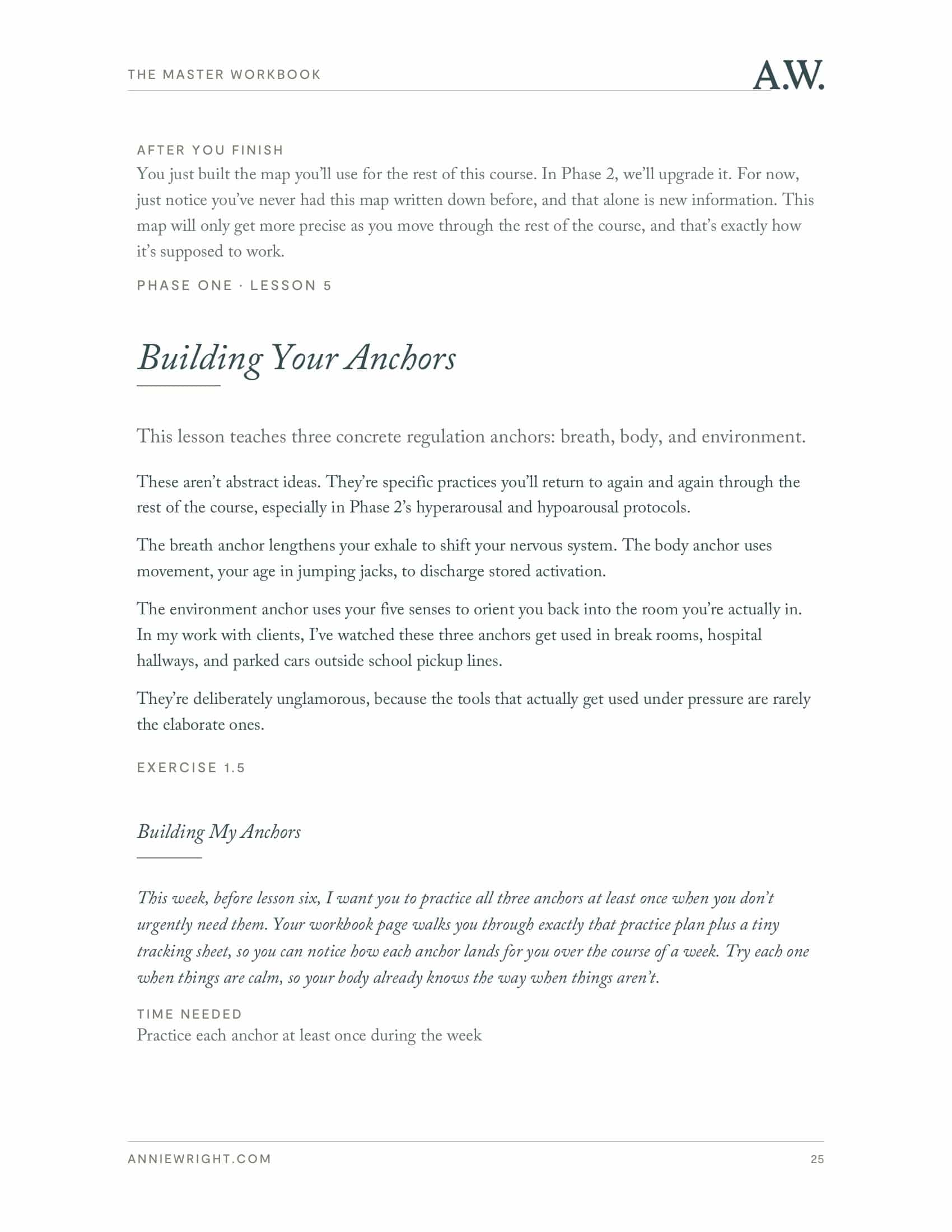
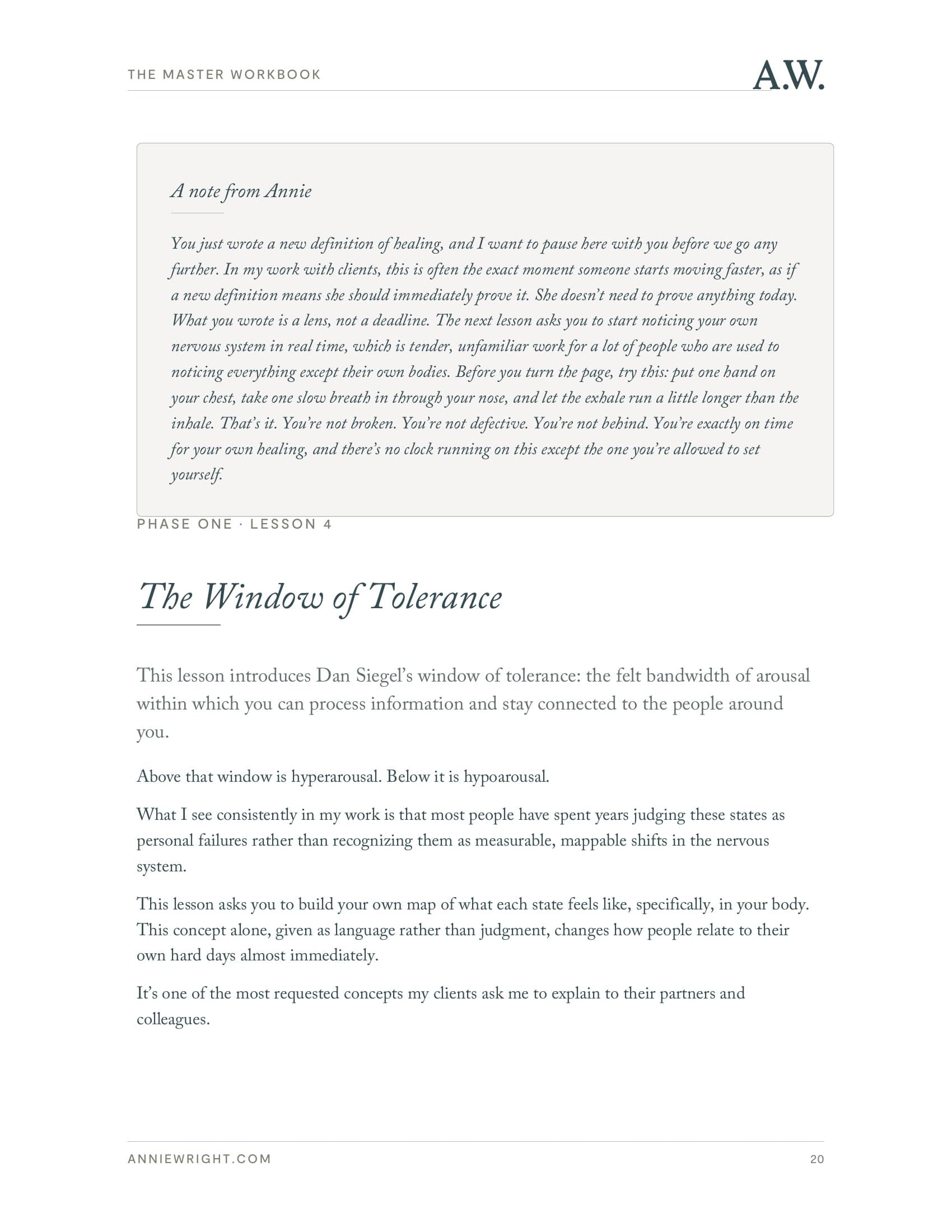
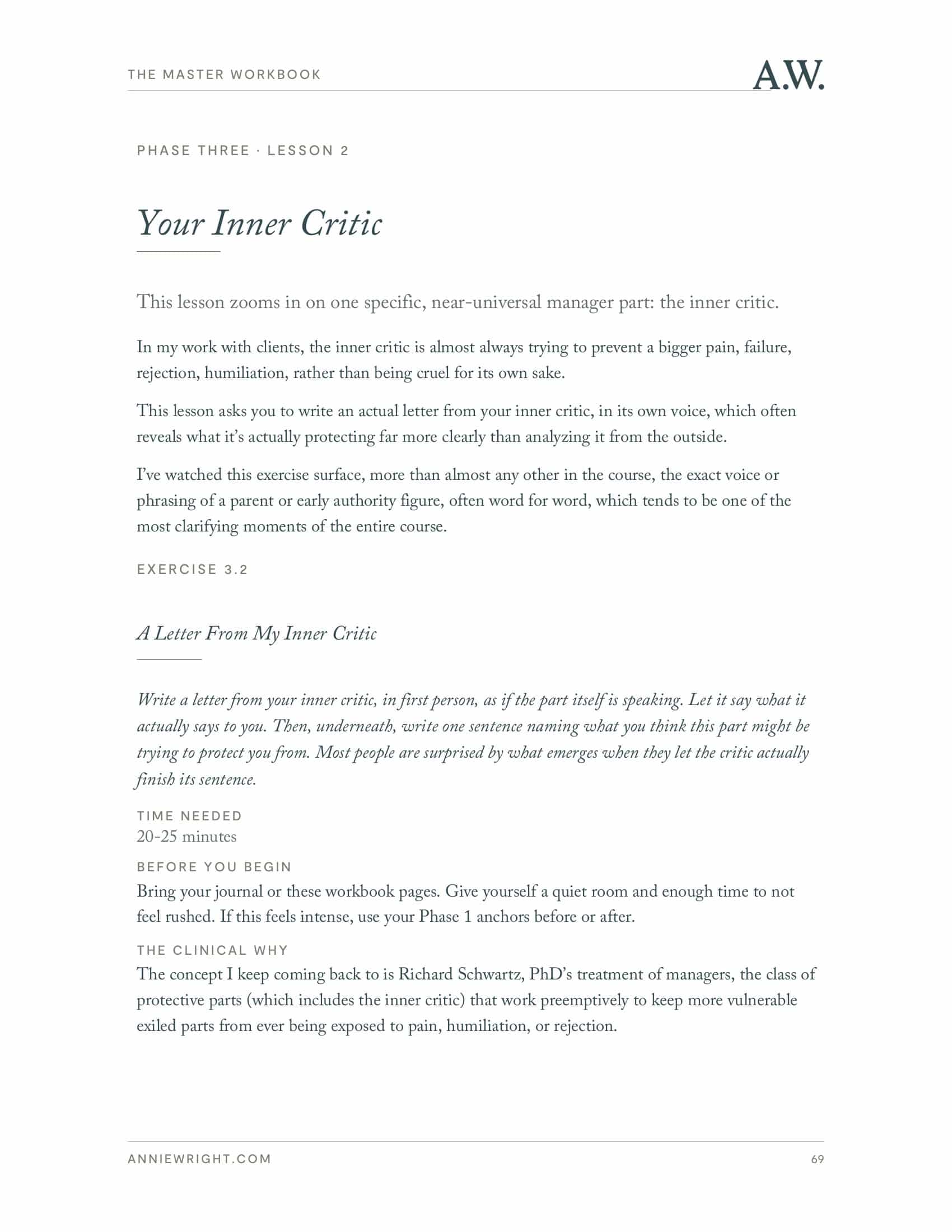
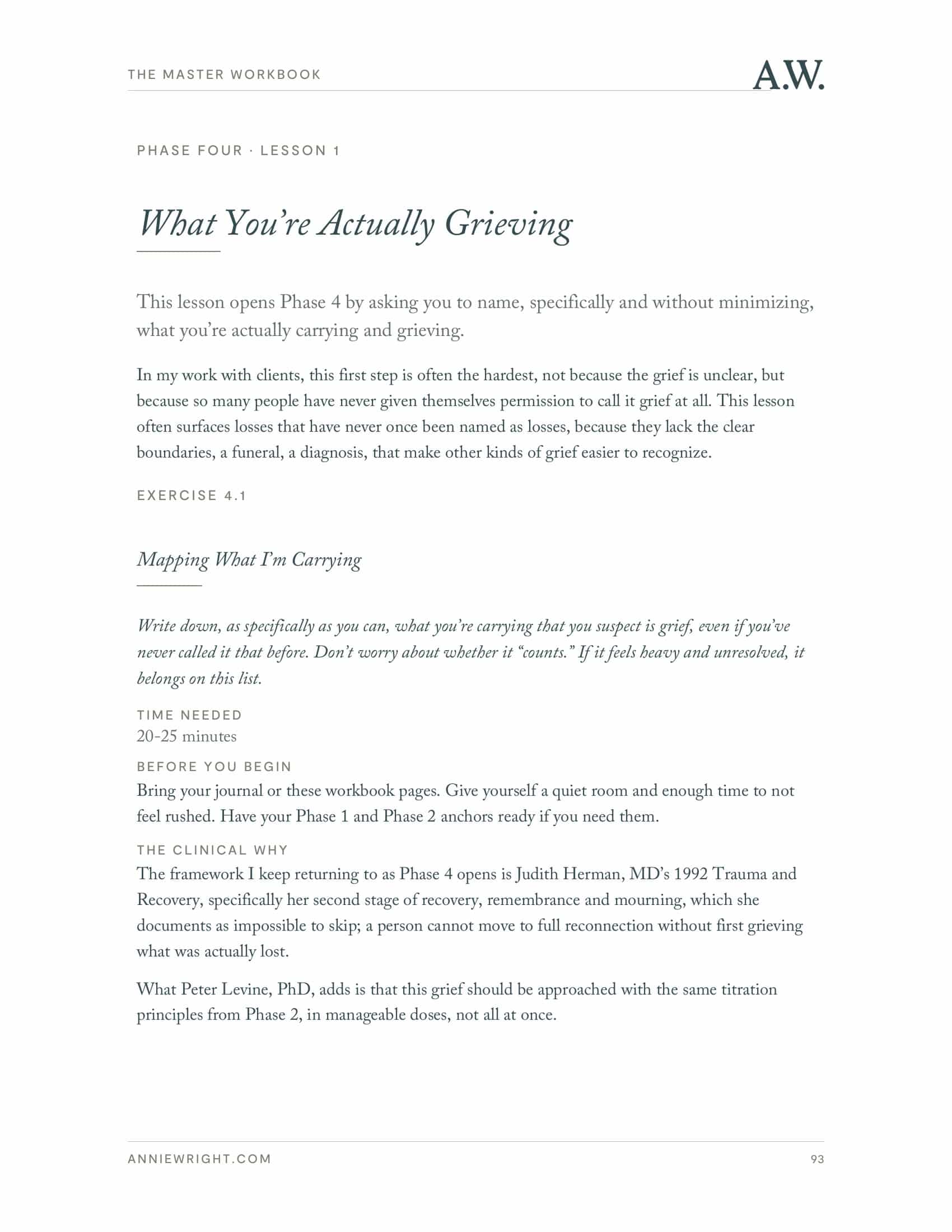
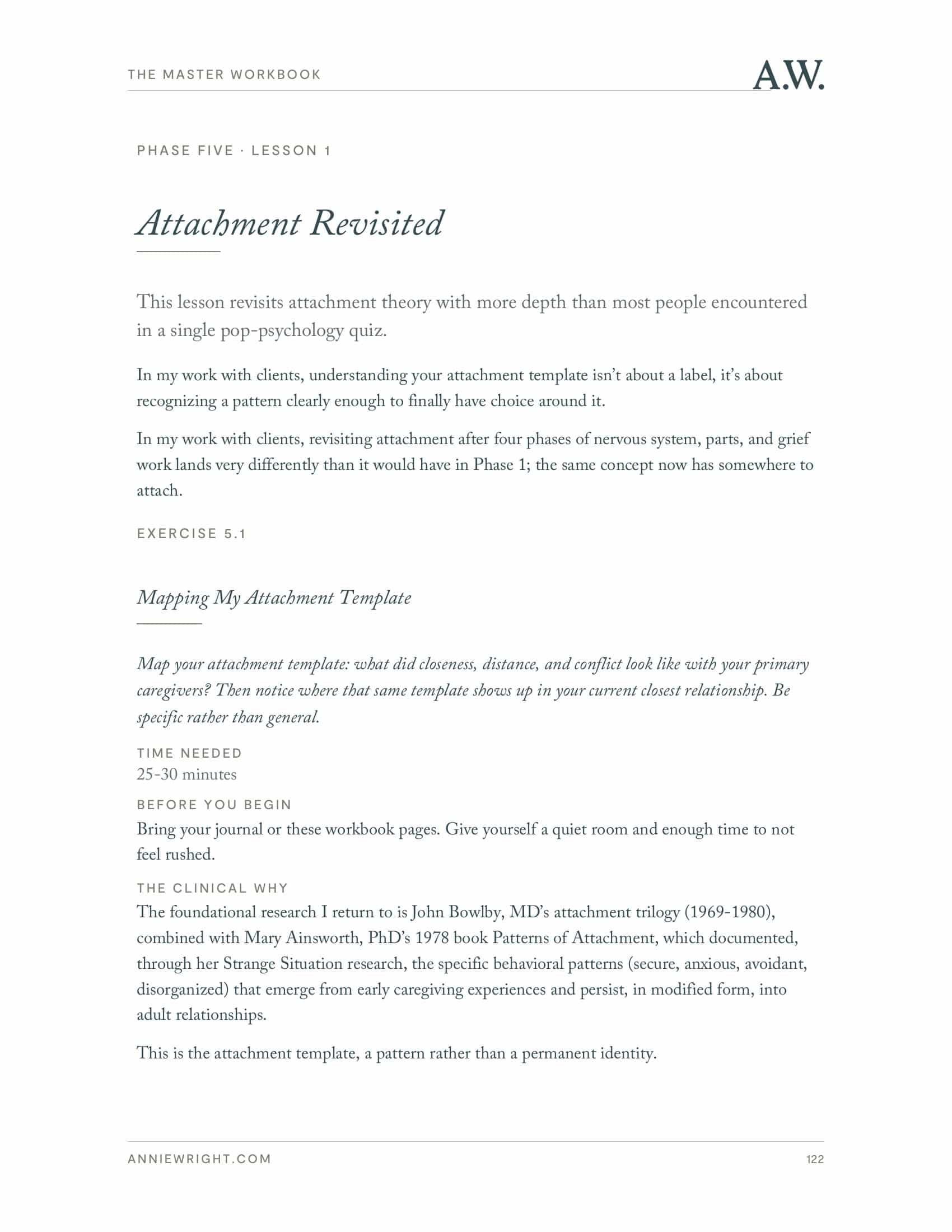
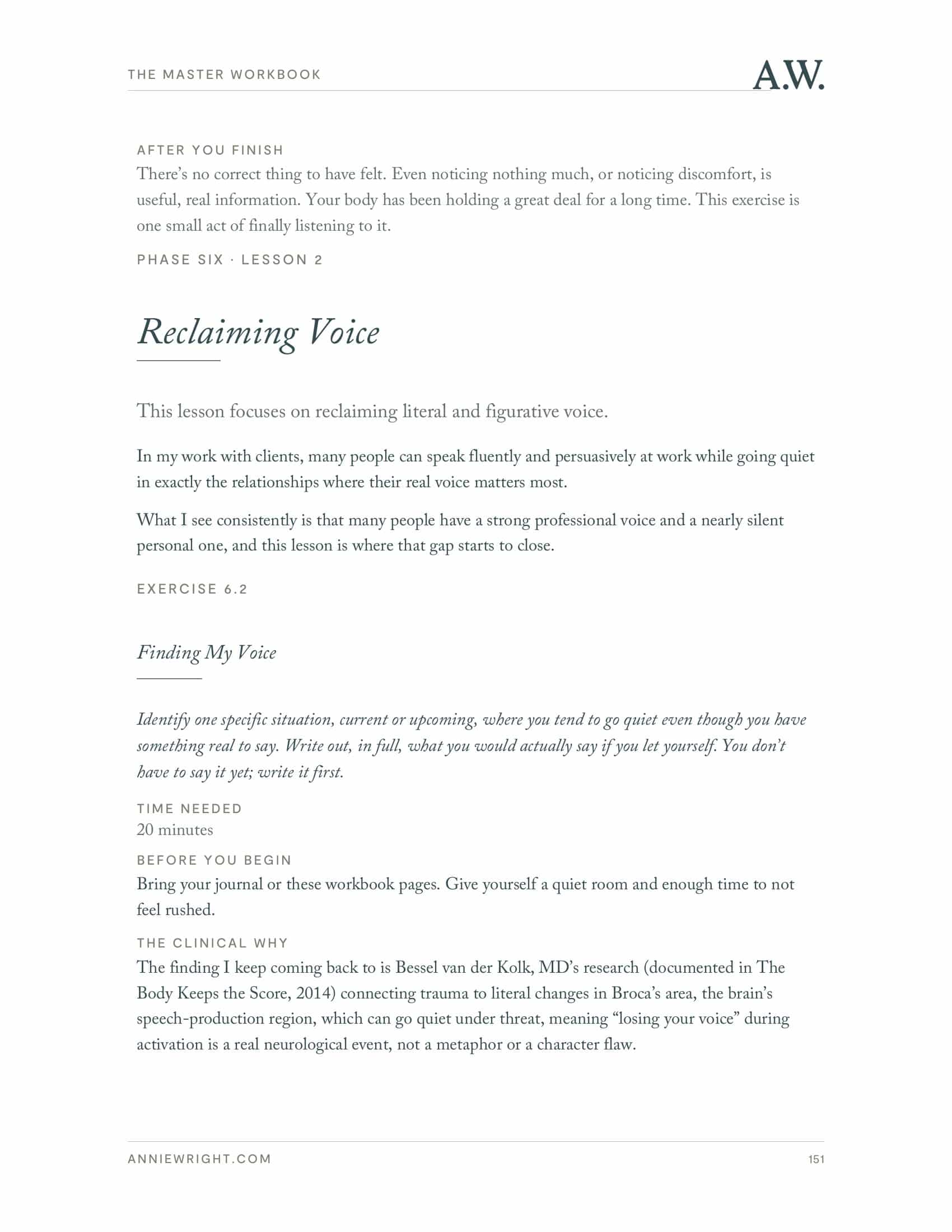
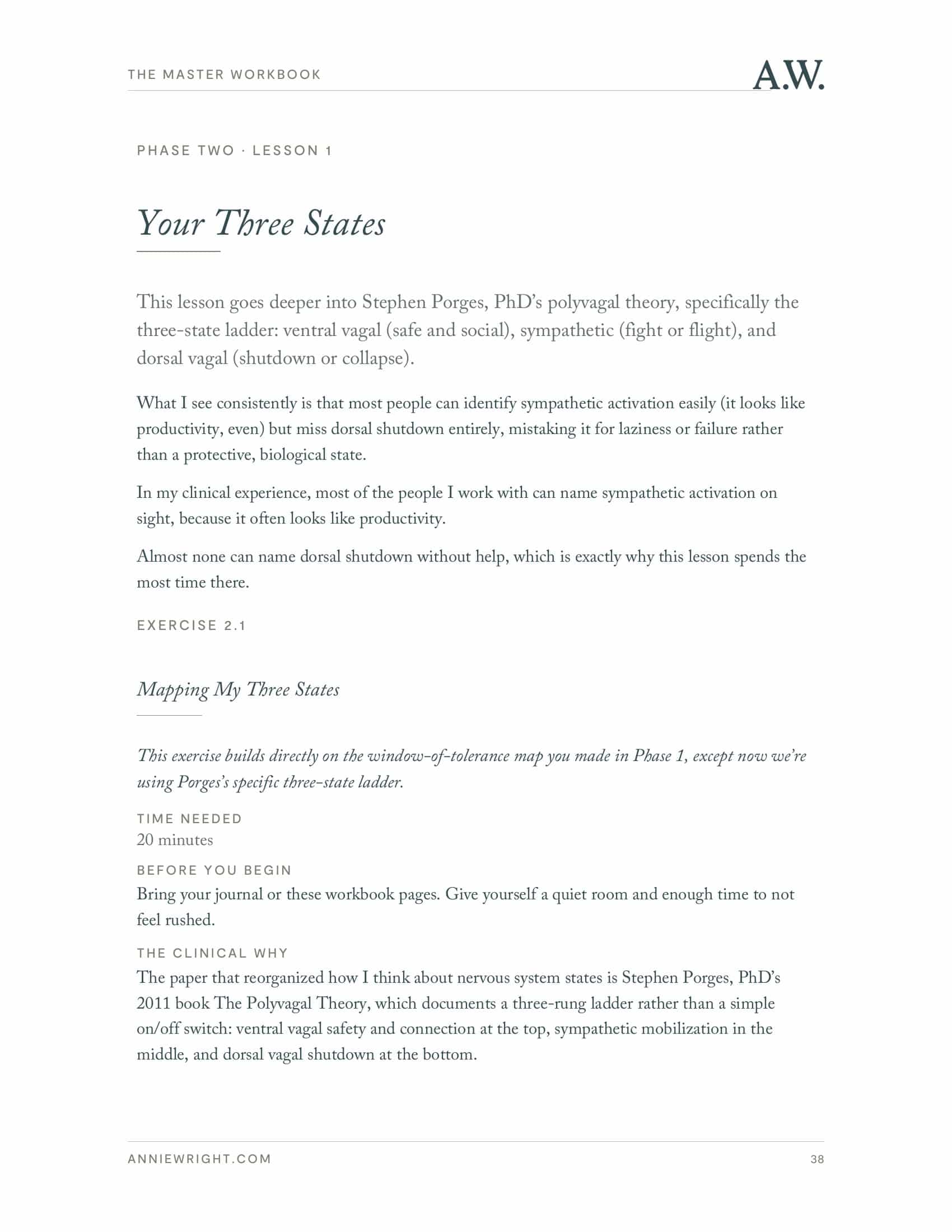
Forty-nine lessons across seven phases. A 180+ page workbook with the exercises my private clients actually do — the somatic protocols, parts-work dialogues, grief letters, attachment maps. Twelve live sessions where you bring me your real material in real time. And two of my standalone $197 courses, included.
Three real exercises from inside the workbook
— from Phase I, Phase II, and Phase III.
For comparison: one hour of 1:1 therapy with Annie is $675. One hour of executive coaching is $900. Live Cohort gives you twelve group sessions where you bring your real material to Annie in real time — plus the full curriculum and both mini-course bonuses — for $1,997.
"My dad called me today crying and we had a good quick conversation where I told him what I need and he responded very well. My therapist congratulated me on the boundaries I set and have been holding. My dad has never done what he did today. Not even close."
"By applying what I learned in this course, I have been able to significantly repair one family relationship and am now slowly mending another. Mom is responding to the boundaries and is less reactive, more respectful. Less reactivity means more calm."
"Annie's work gave me language for something I'd been trying to articulate for years. The clinical framework is rigorous, but it's also deeply human. I finally feel like I'm healing instead of just coping."
"I am better able to disengage from my mum when she crosses boundaries or becomes abusive — and I feel like I'm less affected by it in terms of spiralling."
"I set a boundary with my father and my brothers that I don't think I ever would have set — or even recognized as needing to be set. Thank you."
"By setting boundaries with my parents I am much more relaxed when I visit — and it no longer takes me weeks to 'get over' it."
This work doesn’t just move the people who take it. It moves the therapists who refer it.
“As a therapist myself, Annie’s work is my go-to resource for my clients with complex relational trauma. I can’t count the number of times I have assigned a client the homework of, ‘read Annie Wright’s blog.’ Without fail, my clients report back feeling seen, understood, and less alone.”
“For years, I struggled to find resources that spoke specifically to family estrangement. Annie’s work is the resource I wish I’d had years ago.”
“As a therapist, I’ve seen many wonderful, big-hearted clients struggle to navigate difficult relationships with loved ones. Annie’s course is the missing resource I’ve been looking for.”
“As a fellow trauma therapist, Annie has been someone who I have respected from the very first time I’ve gotten to see her work. She conveys a feeling of humanity and relatability, which is rare in the field of counseling. Her compassion, passion and unending desire to keep expanding her professional skills are visible to all who know her.”
“Annie is one of the warmest and wisest people I know. She’s an expert on complex relational trauma and specializes in EMDR. Exceptionally generous too, sharing her vast knowledge not just with her clients, but also with the world in the form of her informative free-access blog and writings. Annie is a gem — both as a therapist and as a leader in the mental health profession altogether.”
“Annie is a skilled, compassionate clinician and a leader in her field. I’ve known her for 10 years and admire her passion for clinical excellence. You can tell Annie truly cares about people; she leads with heart and offers her wisdom through all of her online offerings. Highly recommend working with her if you get the chance.”
Tap any question to read the answer
Already on Annie's email list? You're not automatically on the FTF waitlist — add yourself above.
The cohort starts September 22. Cart closes September 18 at midnight ET. After that, the next live cohort isn't until 2027.
Add Yourself to the Waitlist