Fixing the Foundations™ · Annie Wright, LMFT · Relational Trauma Recovery Course
You’ve done therapy. You’ve read the books. You’ve listened to the podcasts. And you still feel stuck.

Fixing the Foundations

Sarah did three years of weekly therapy. She’d read the books, listened to the podcasts, could name every pattern in her family of origin. And still, every time her mother’s name showed up on her phone, Sarah felt her stomach drop and her chest get hot. She knew she was an independent 44-year-old woman and not a fourteen-year-old girl. Her body didn’t seem to understand that. She’d started to think therapy just didn’t work on her.

Fixing the Foundations is what changes that.

Join the Fixing the Foundations Waitlist $1,997 paid in full, or 3 payments of $699. Self-paced, lifetime access. Opens Fall 2026. A self-paced psychoeducational course. Not a substitute for therapy. Fourteen-day refund window. Course terms.
Annie’s expert commentary has appeared in
The Washington Post Forbes Business Insider NBC News The Information
The patterns you can’t stop

You might recognize yourself here.

The flinch that won’t leaveYour parent’s name lights up your phone and your chest goes tight before you’ve even decided whether to answer. You’re not fourteen anymore. You’ve had years of therapy. You can explain exactly why this happens. You still can’t stop it from happening.
Turning into a parent you swore you wouldn’tYou hear your parent’s exact words come out of your own mouth. You catch yourself using the same tone, the same silence, the same withdrawal. You swore you’d never do this. You can’t figure out how to stop.
The invisible alonenessYou have people who would call you close. But the list of people you can actually cry in front of is one name long, maybe zero. Every person you’d contact in a real crisis is someone you pay: a therapist, a coach, a housekeeper. The gap between how loved you look and how held you feel is the thing you never talk about.
The same partner in different clothesYou keep ending up with the same person in a different body. Different name, different job, same infuriating patterns. You can see it happening. You still don’t know how to want something else.
The 3am ceilingIt’s 3:14am and you’re staring at the ceiling. Nothing catastrophic happened today. Your body still won’t come down. You’ve tried the melatonin, the magnesium, the sleep hygiene, the meditation app. Sleep is not the problem. Your nervous system doesn’t know it’s safe to rest.
The thing you fill it withYou have a thing you reach for when the tightness comes. Two glasses of wine most weeknights. The online cart at 11pm. The scroll that eats two hours. The snack you don’t remember eating. You’ve tried to stop. It comes back. You’ve never told anyone the actual size of it.

If any of these read like your journaling, you’re in the right place. This is what Fixing the Foundations is for.

Who trusts this work
28,000+
Readers on Annie’s weekly newsletter, Strong and Stable.
W. W. Norton
First book under contract with the publisher of Bessel van der Kolk, PhD; Judith Herman, MD; and Peter Levine, PhD.
National Press
Expert commentary in the Washington Post, Boston Globe, USA Today, Forbes, and Business Insider.

15,000+ clinical hours. Licensed in 14 U.S. jurisdictions, plus a Florida telehealth registration. This is a course built by a practicing therapist and clinical educator who is one of the leading voices on relational trauma recovery.

What readers say about Annie’s writing

Words from readers.

Fixing the Foundations is a new course and it has no course testimonials yet. These are words readers have sent about Annie’s free writing, the blog and the newsletter. They are about the writing, not about this course, and not about therapy. The course is built in the same voice.

“Annie, with your writing, you are making an important contribution to a wider audience than could ever meet with you one on one. You’re a gifted writer, you offer empathy and clear headed explanations for complicated issues. You address real life issues in a user friendly/supportive way. It’s beautiful and a gift. AND, you back up what you say with solid research.” L.R., reader
“Thank you for another incredibly beautiful post, Annie. It resonated so deeply with me that I looked back in a folder where I keep ‘doodles,’ things I have drawn or written at times that I feel something rising up that needs to be acknowledged.” Mary, reader
“Whenever I think the blog isn’t going to apply to me, it always hits the nail on the head. Thank you, Annie!” Robin, reader

More words from readers are on the full testimonials page.

You didn’t choose the relational patterns you grew up with, but your body still runs on them. Fixing the Foundations is what changes that.
Join the Fixing the Foundations Waitlist
Start Here

You’ve built a whole life on a proverbial foundation nobody helped you pour.

Your manager’s expression shifts slightly in a meeting, a small tightening around the eyes, and before you’ve had a single conscious thought, your heart rate is up and you’re already softening your position, already working to smooth something that might not even be a problem. You catch it happening. You can’t stop it. Your partner asks what you want for dinner. You say “whatever you want.” Not because you don’t have a preference. Because having preferences still feels, somewhere underneath the adult logic, like a risk. You can handle a genuine crisis without flinching. You come home and your kid won’t put their shoes on and something in you goes sideways. It's a surge bigger than the moment, belonging to something much older than your child. You know exactly why you do these things. You keep doing them anyway. You lie awake replaying a conversation from three days ago, still editing your part of it, still looking for where you went wrong. You don’t even remember what it was about anymore. You just remember the feeling. This isn’t a you problem. It’s a foundation problem. The proverbial house of your life has an upper story you’ve worked hard to build: the career, the relationships, the life that looks right from the outside. But the foundation underneath it was poured early, under conditions nobody addressed at the time, and it’s still running the show. Fixing the Foundations is where that structural work happens.
Does this feel familiar?

You've been carrying a lot of this alone.

These are the patterns I see across my practice, week after week. Tap any card below to see how we work with it inside the course.

Why does my body react before my brain does?
Why does my family still get to me like this?
Why is the voice in my head so relentlessly unkind?
Why do I keep ending up in the same situation?
Your body isn’t failing you in the meeting, the marriage, or the middle of the night. It’s still following instructions it learned early on, and those instructions aren’t helpful anymore. Fixing the Foundations gives it new ones.
Join the Fixing the Foundations Waitlist
Who this is for

This is for you.

You don’t need to have done years of therapy to belong here. You just need to be someone who’s ready to look at the patterns underneath.

This is for you if…
  • You keep ending up in the same relational patterns with different people
  • Your body reacts to a parent’s name on your phone in a way you can’t reason your way out of
  • You catch yourself using your parent’s exact tone, silence, or withdrawal on the people you love, and you can’t stop it
  • You’ve read the books, listened to the podcasts, know the theory, and can’t figure out why nothing has actually changed
  • You’ve done years of therapy and can explain everything in complete sentences, and you still feel stuck in the same places
  • You’ve never been to therapy but you know something isn’t working underneath, and you want a serious place to start
  • You’re tired of talking about it without anything shifting
  • You want a written map you can return to on your own time, at your own pace
  • Something looks fine on the outside of your life and doesn’t feel fine underneath
  • You’re ready to look at what the theory hasn’t yet landed in your body
This is not for you if…
  • You’re in an active mental health crisis and need immediate, in-person care.
  • You’re looking for a quick fix or a five-day protocol.
  • You want live group calls or a scheduled group experience.
  • You want a therapist-client relationship, not a self-paced course.
  • You’re not ready to look at family-of-origin patterns.
  • You’re expecting someone else to do this for you.
  • You need a formal diagnosis or a treatment plan.

Click either column to read the honest version of who Fixing the Foundations is built for.

Exactly what’s inside

Here’s every lesson

48 lessons. 50 written exercises. A 200-page workbook. Seven phases in the clinical order that works.

Fixing the Foundations works at the level of the proverbial foundation, the early wiring underneath the polished adult life. In my work with clients, I’ve watched people try to begin with the grief, the relationship, the thing that hurts most, then conclude they’ve failed when their body gets overwhelmed. The order is the intervention. Phase 1 gives you the tools. Phase 2 teaches you how to use them. Then we go deeper.

01 Phase 1, Orientation 6 lessons
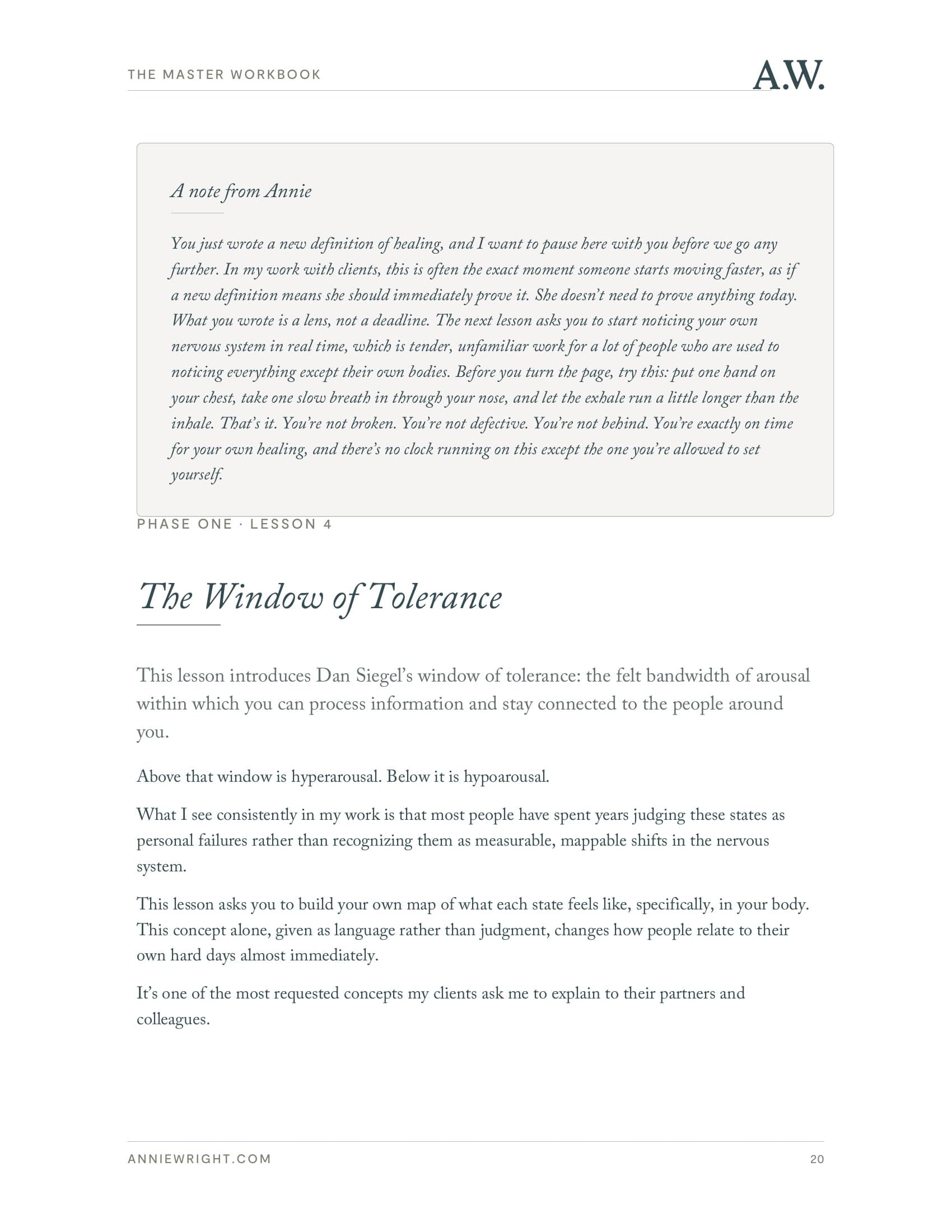
Before we touch the material that can make your throat close or your inbox suddenly feel impossible, we build a realistic rhythm, a map of your window of tolerance, and three concrete anchors. This is the phase that helps you close the workbook on a hard Thursday and return to it next week instead of disappearing from the work altogether.

Grounded in the work of Judith Herman, MD; Dan Siegel, MD; Peter Levine, PhD; Stephen Porges, PhD; Carl Rogers, PhD; James Pennebaker, PhD; Diana Fosha, PhD; and Bessel van der Kolk, MD. I built this opening around the clinical sequence I keep coming back to: safety and stabilization before deeper processing.

  • Lesson 1.1: Why You’re Here. Accompanying exercise: Why I’m Here.3 workbook pages, pages 10 to 12
  • Lesson 1.2: Your Course Rhythm. Accompanying exercise: My Course Rhythm.4 workbook pages, pages 13 to 16
  • Lesson 1.3: Rewriting What Healing Means. Accompanying exercise: Rewriting My Definition of Healing.3 workbook pages, pages 17 to 19
  • Lesson 1.4: The Window of Tolerance. Accompanying exercise: Mapping My Window.5 workbook pages, pages 20 to 24
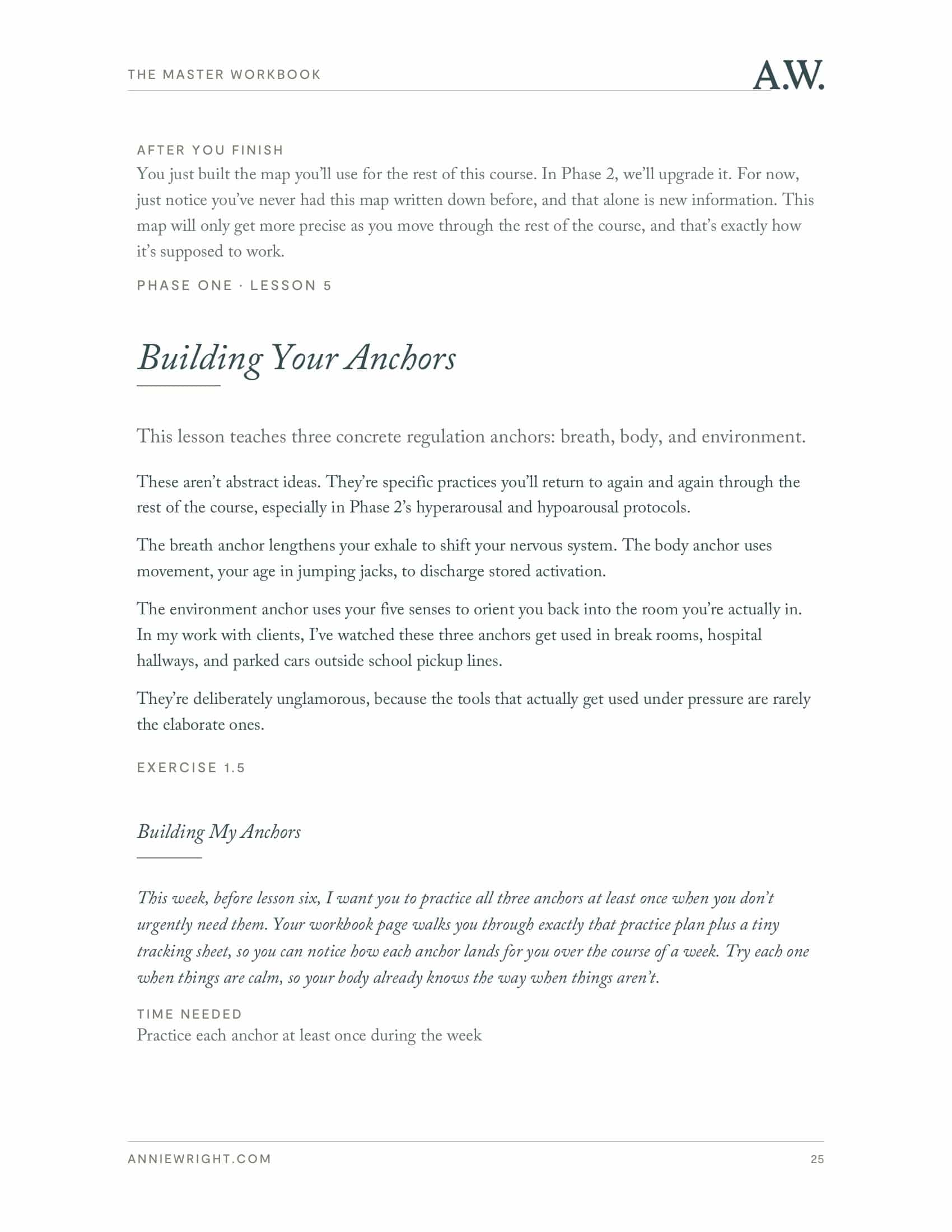
  • Lesson 1.5: Building Your Anchors. Accompanying exercise: Building My Anchors.4 workbook pages, pages 25 to 28
  • Lesson 1.6: Closing Phase One. Accompanying exercises: Phase One Inventory and Letter to Future Self.7 workbook pages, pages 29 to 35

This matters because you don’t use a brand-new regulation tool for the first time in the middle of a fight, a board meeting, or a 9pm phone call that has already sent your body into overdrive. You practice it while things are calm. That is how it becomes available later.

02 Phase 2, Somatic and Nervous System Stabilization 7 lessons
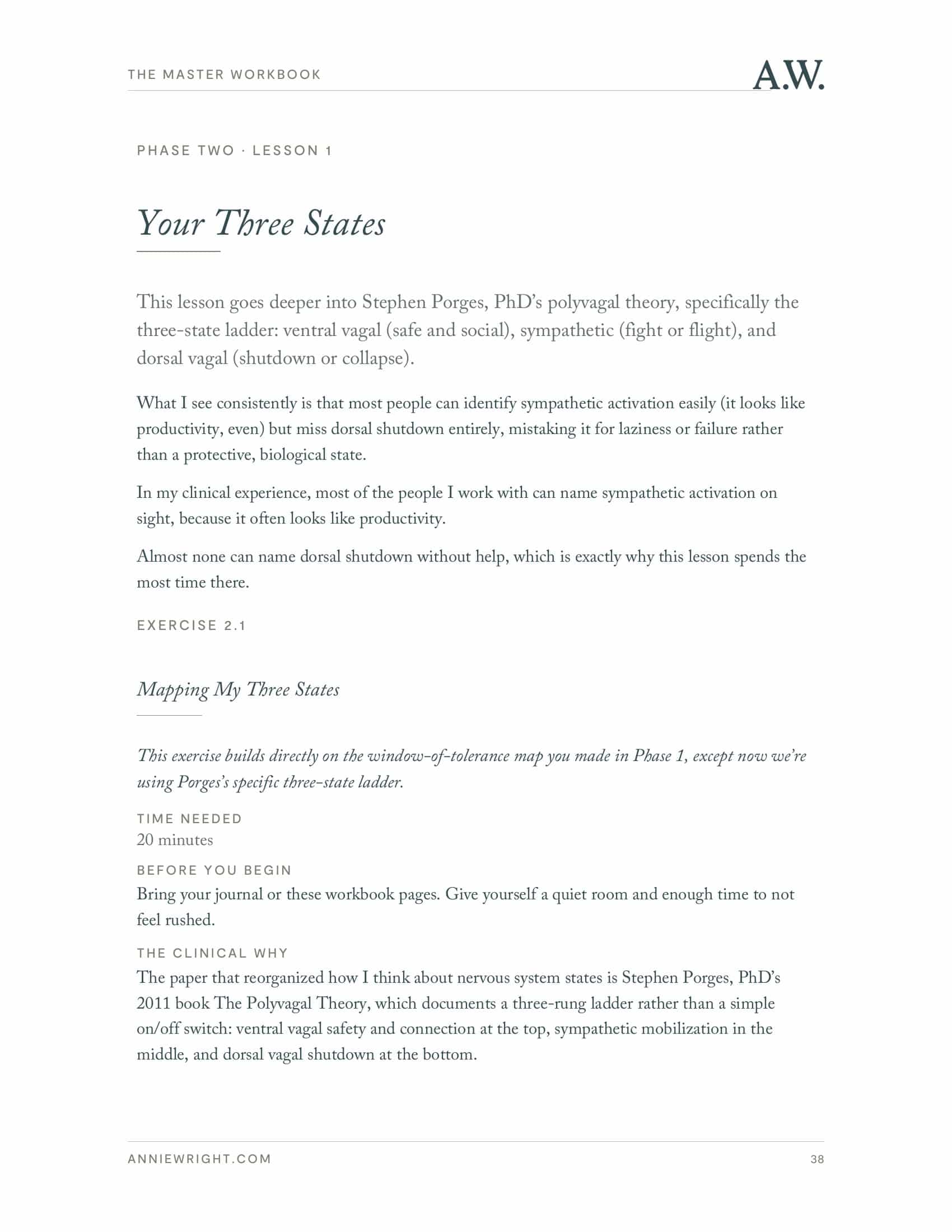
Your nervous system doesn’t have two settings, fine and failing. This phase gives you a more accurate map: safe and connected, mobilized and running hot, or shut down and gone flat. Then it helps you build a different recovery plan for each one, because the thing that helps when you’re spiraling at 4pm isn’t always the thing that helps when you’re staring at the same Netflix screen for eleven minutes.

Grounded in the work of Stephen Porges, PhD; Peter Levine, PhD; Dan Siegel, MD; Pat Ogden, PhD; John Bowlby, MD; and Ed Tronick, PhD. I kept returning to these clinicians and researchers because they gave language to what I’d watched for years: your body can be doing something very intelligent long before your thinking mind catches up.

  • Lesson 2.1: Your Three States. Accompanying exercise: Mapping My Three States.3 workbook pages, pages 38 to 40
  • Lesson 2.2: Co-Regulation. Accompanying exercise: My Co-Regulation Inventory.3 workbook pages, pages 41 to 43
  • Lesson 2.3: Titration and Pendulation. Accompanying exercise: Practicing Titration on a Small Charge.4 workbook pages, pages 44 to 47
  • Lesson 2.4: Daily Vagal Practice. Accompanying exercise: My Daily Vagal Practice Stack.4 workbook pages, pages 48 to 51
  • Lesson 2.5: Hyperarousal Recovery. Accompanying exercise: My Hyperarousal Recovery Plan.4 workbook pages, pages 52 to 55
  • Lesson 2.6: Hypoarousal Recovery. Accompanying exercise: My Hypoarousal Recovery Plan.3 workbook pages, pages 56 to 58
  • Lesson 2.7: The Healthy Mind Platter. Accompanying exercise: My Healthy Mind Platter Audit.5 workbook pages, pages 59 to 63

Think of this phase like learning your own kitchen before you try to cook a complicated meal. You learn where the fire extinguisher is, what the smoke alarm sounds like, and which burner runs too hot. Then, when your boss sends the email or your partner gets quiet, you have a plan that belongs to your actual body.

03 Phase 3, Parts Work 7 lessons
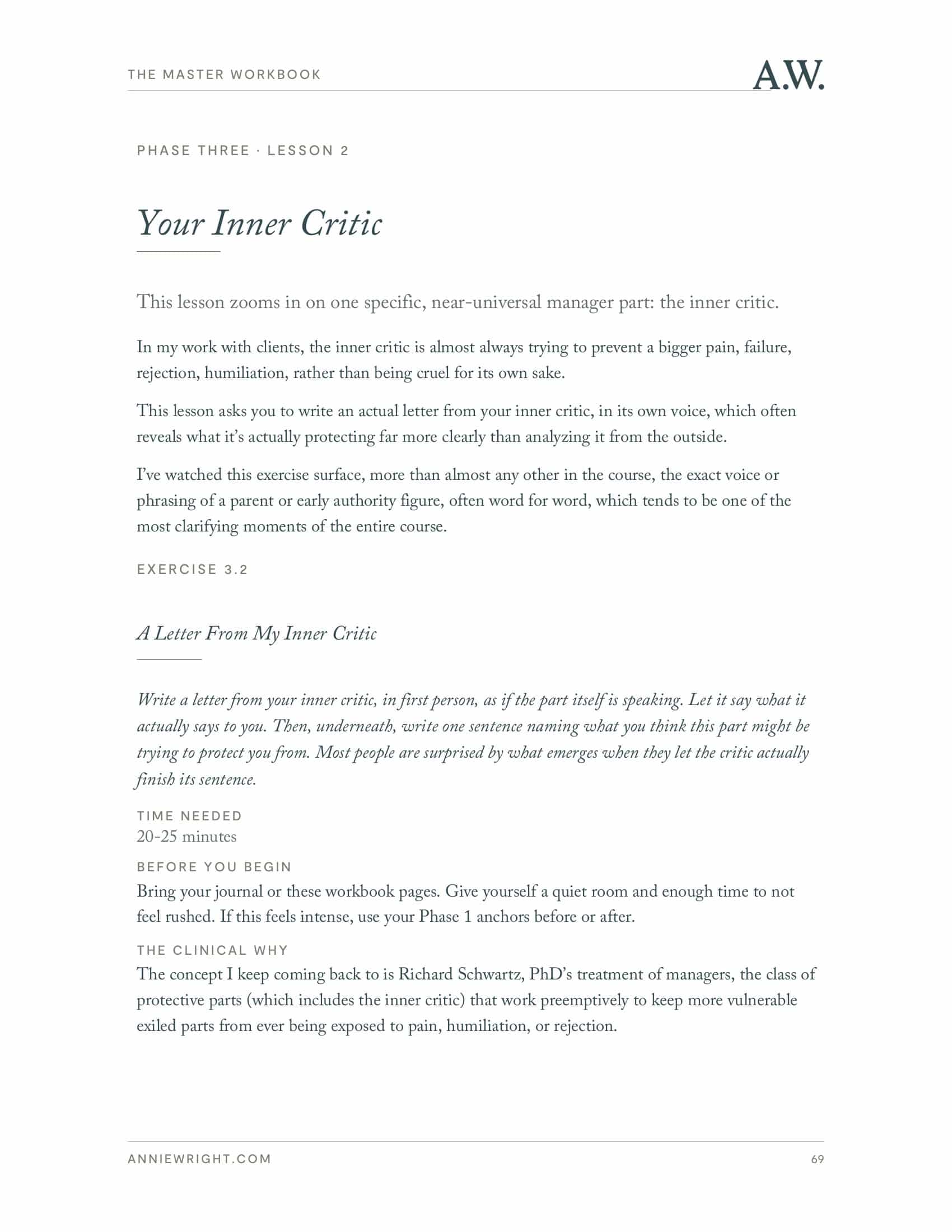
The inner critic. The part that runs the calendar so tightly there’s no room left to breathe. The part that reaches for wine, work, shopping, scrolling, or a fight when something tender gets close. This phase helps you meet those parts without treating any of them like evidence that you’re defective.

Grounded in the work of Richard Schwartz, PhD; Diana Fosha, PhD; Bessel van der Kolk, MD; Kristin Neff, PhD; Dan Siegel, MD; and John Bowlby, MD. Richard Schwartz, PhD’s parts framework changed the way I understand the person who knows exactly what they’re doing and still finds themselves doing it at 11pm. There isn’t one broken self to fix. There are protective parts with old jobs.

  • Lesson 3.1: Meeting Your Parts. Accompanying exercise: Naming the Parts I Already Know.3 workbook pages, pages 66 to 68
  • Lesson 3.2: Your Inner Critic. Accompanying exercise: A Letter From My Inner Critic.4 workbook pages, pages 69 to 72
  • Lesson 3.3: Mapping Your Managers. Accompanying exercise: Mapping My Top Three Managers.3 workbook pages, pages 73 to 75
  • Lesson 3.4: Your Firefighters. Accompanying exercise: My Firefighter Inventory.4 workbook pages, pages 76 to 79
  • Lesson 3.5: Meeting the Exile. Accompanying exercise: A First, Gentle Letter.3 workbook pages, pages 80 to 82
  • Lesson 3.6: Unblending in Real Time. Accompanying written exercise.4 workbook pages, pages 83 to 86
  • Lesson 3.7: Recognizing Self-Energy. Accompanying exercise: Recognizing My Self-Energy.4 workbook pages, pages 87 to 90

A manager part is a little like the person in your house who took over every bill, every birthday, every possible emergency because nobody else was doing it. That part is exhausted. It is exhausting everyone around it. But it got that job for a reason. We start there.

04 Phase 4, Grief 8 lessons
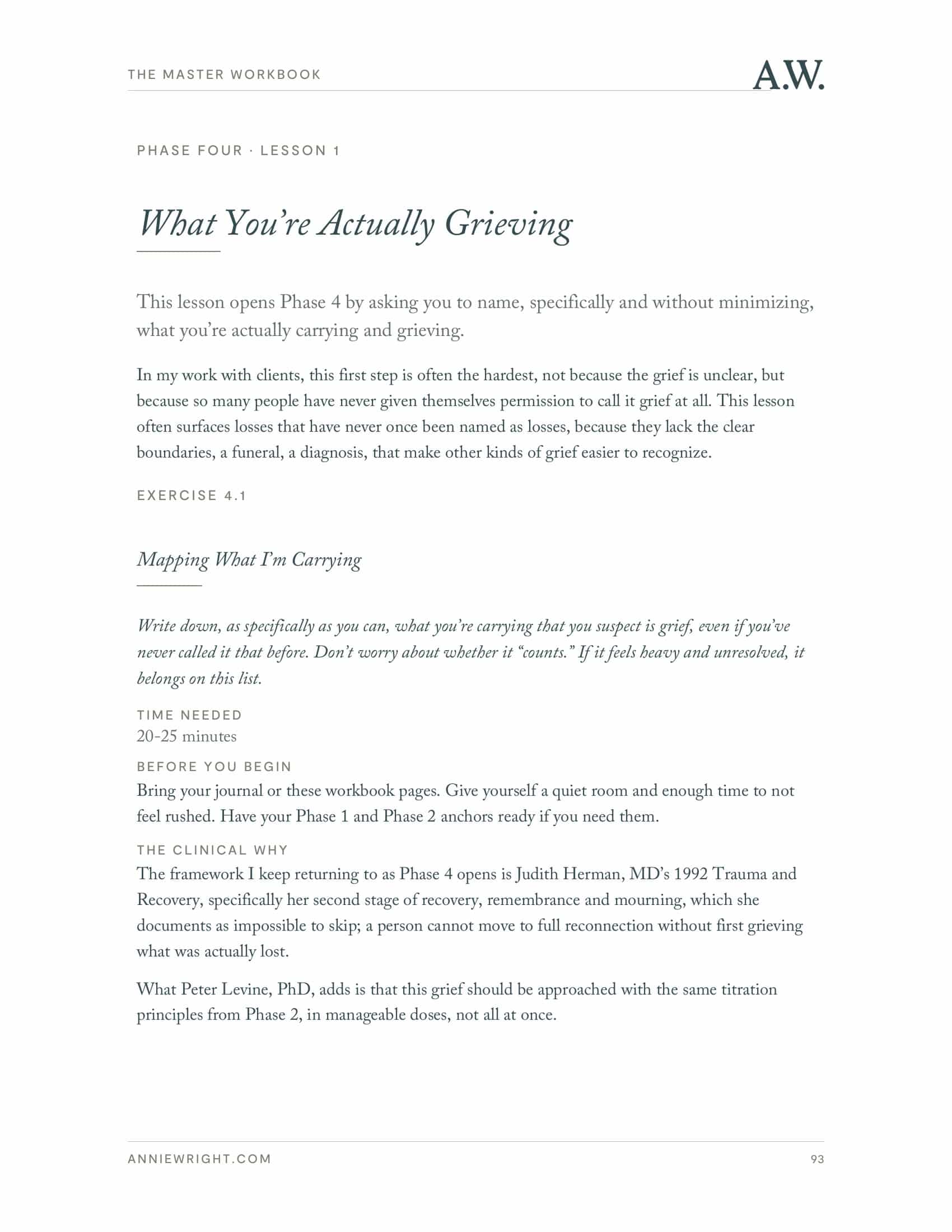
This is grief for what should have happened and didn’t. The parent who could not meet you. The childhood where you learned to be easy, invisible, endlessly useful, or fine. The losses that never got a funeral because nobody around you called them losses in the first place.

Grounded in the work of Judith Herman, MD; Kenneth Doka, PhD; Pauline Boss, PhD; Peter Levine, PhD; Richard Schwartz, PhD; Diana Fosha, PhD; Kristin Neff, PhD; and Donald Winnicott, MD. I found Kenneth Doka, PhD’s language for disenfranchised grief and Pauline Boss, PhD’s work on ambiguous loss after sitting with too many people who had a real ache and no socially acceptable name for it.

  • Lesson 4.1: What You’re Actually Grieving. Accompanying exercise: Mapping What I’m Carrying.3 workbook pages, pages 93 to 95
  • Lesson 4.2: Disenfranchised Grief. Accompanying exercise: Giving Grief Permission.3 workbook pages, pages 96 to 98
  • Lesson 4.3: The Five Losses. Accompanying exercise: Naming the Five Losses.4 workbook pages, pages 99 to 102
  • Lesson 4.4: Grieving the Parent You Deserved. Accompanying exercise: The Parent I Needed.3 workbook pages, pages 103 to 105
  • Lesson 4.5: IFS and the Grief-Holding Parts. Accompanying exercise: Meeting the Part Who Holds the Grief.4 workbook pages, pages 106 to 109
  • Lesson 4.6: Ritual, Witness, and Somatic Mourning. Accompanying exercise: Designing a Mourning Practice.3 workbook pages, pages 110 to 112
  • Lesson 4.7: Moving Through, Not Over. Accompanying exercise: Mapping My Grief Integration.3 workbook pages, pages 113 to 115
  • Lesson 4.8: From Grief to Compassion. Accompanying written exercise.4 workbook pages, pages 116 to 119

You won’t be asked to rip open every cabinet in the proverbial house of your life and sit in the debris. You’ll work with grief in a container, with a beginning and an end, because grief needs witness and a place to land, not another demand to get over it.

05 Phase 5, Attachment and Relationships 7 lessons
This is where we take the patterns out of theory and into the marriage, the text thread, the work partnership, the family dinner. You’ll look at the relationship template you learned early, then practice boundaries, conflict, repair, vulnerability, and the unnerving skill of choosing people who feel safe instead of merely familiar.

Grounded in the work of John Bowlby, MD; Mary Ainsworth, PhD; Mary Main, PhD; John Gottman, PhD; Ed Tronick, PhD; Pat Ogden, PhD; Stephen Porges, PhD; Peter Levine, PhD; and Dan Siegel, MD. Mary Main, PhD’s work on earned secure attachment is one I come back to often, because it gives us a hopeful truth that is not sentimental: the old template can be understood and revised.

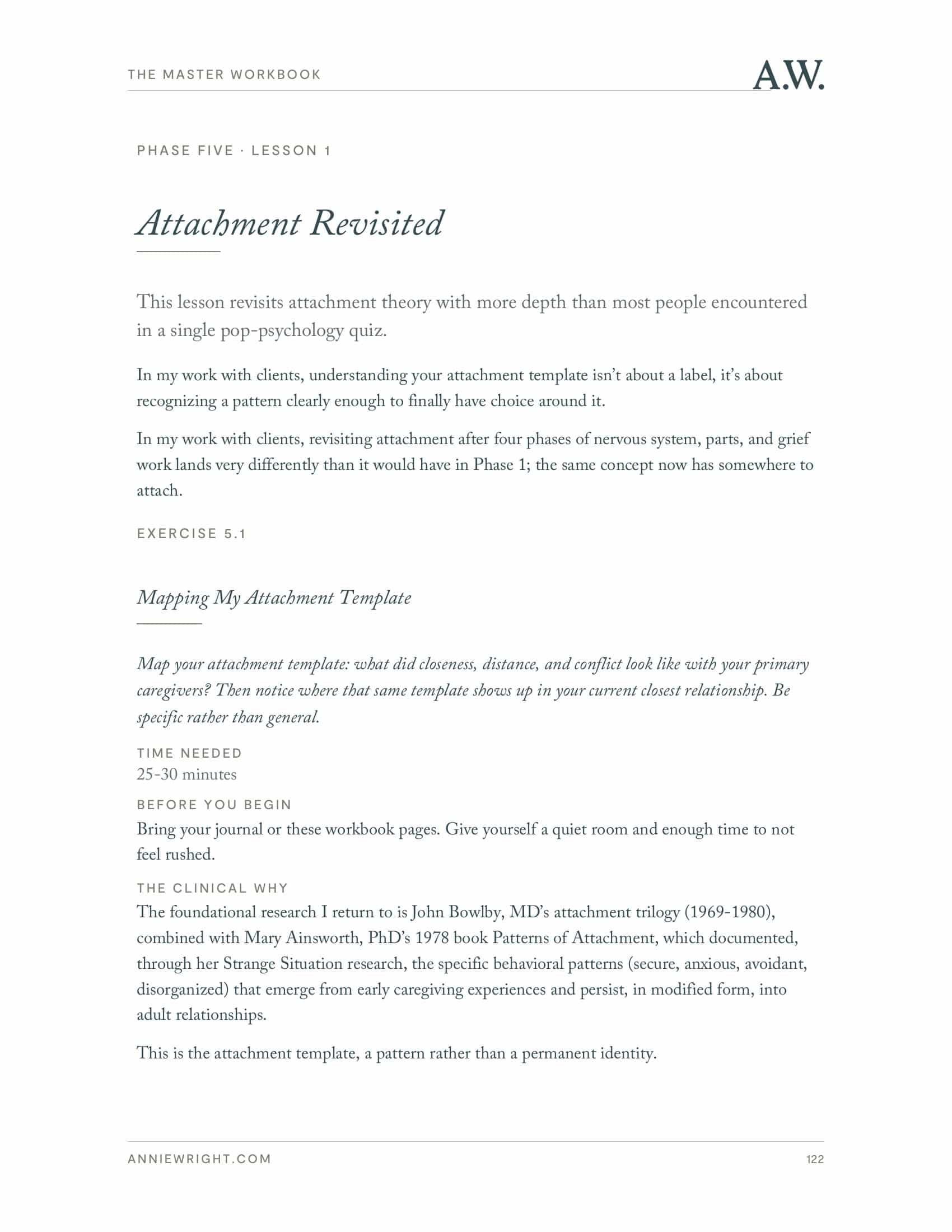
  • Lesson 5.1: Attachment Revisited. Accompanying exercise: Mapping My Attachment Template.3 workbook pages, pages 122 to 124
  • Lesson 5.2: Earned Secure Attachment. Accompanying exercise: Building My Coherent Narrative.5 workbook pages, pages 125 to 129
  • Lesson 5.3: Boundaries as Love. Accompanying exercise: Mapping My Boundary Landscape.3 workbook pages, pages 130 to 132
  • Lesson 5.4: Conflict as Connection. Accompanying exercise: My Conflict Map.3 workbook pages, pages 133 to 135
  • Lesson 5.5: Repair After Rupture. Accompanying exercise: My Repair Practice.3 workbook pages, pages 136 to 138
  • Lesson 5.6: Intimacy and Vulnerability. Accompanying exercise: Calibrating My Vulnerability.3 workbook pages, pages 139 to 141
  • Lesson 5.7: Choosing Wisely. Accompanying exercise: Recognizing the Familiar Wound.4 workbook pages, pages 142 to 145

Attachment is not a personality quiz result you get sentenced to live with. It is a set of early instructions about closeness. This phase helps you notice the instructions before they quietly write another text, pick another fight, or make someone kind feel strangely uninteresting.

06 Phase 6, Reclamation of Self 7 lessons
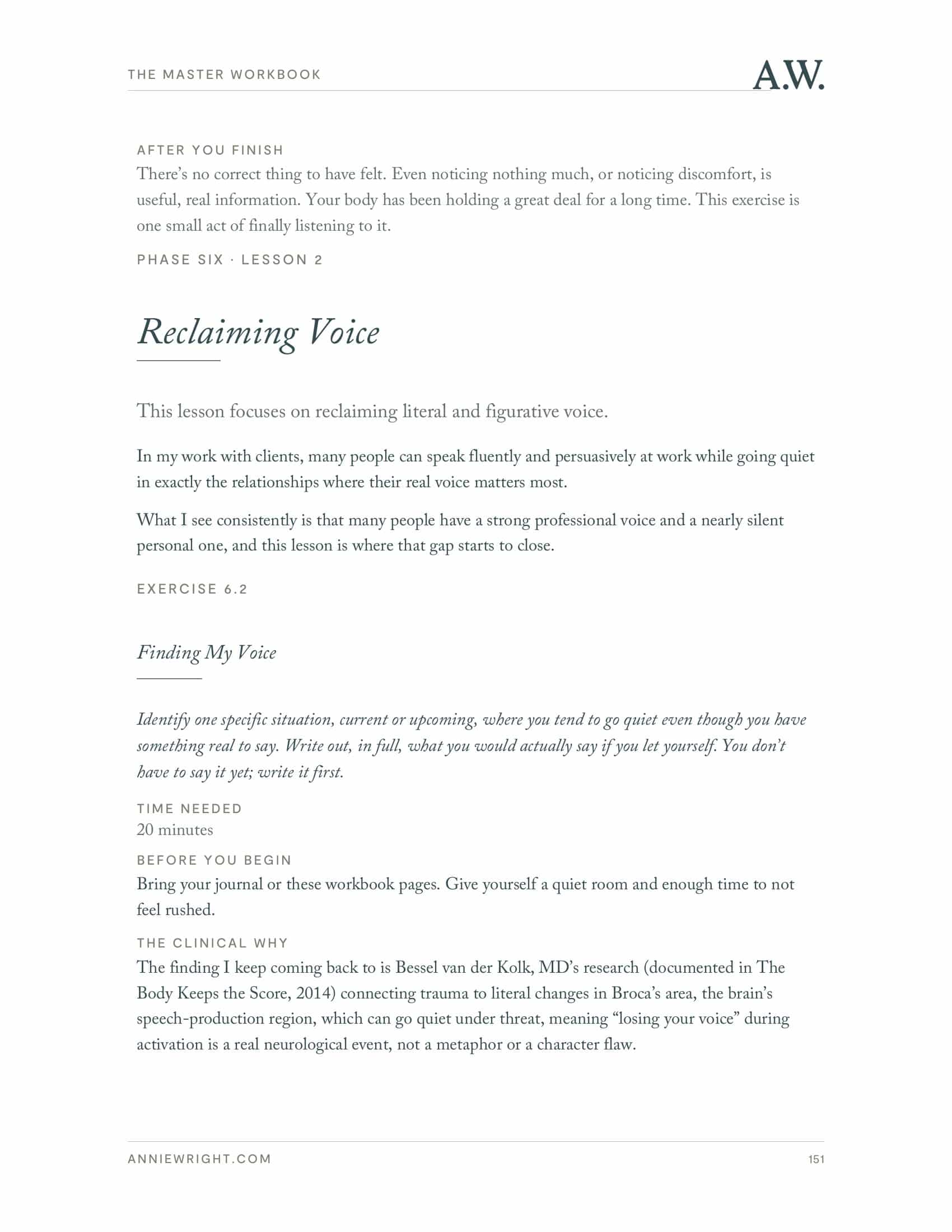
There are things you may have learned to put away because they were inconvenient in the family you came from: anger, pleasure, play, voice, rest, the ability to stay inside a good moment without waiting for the floor to drop out. This phase is where you begin to reclaim them, carefully and on purpose.

Grounded in the work of Bessel van der Kolk, MD; Peter Levine, PhD; Stephen Porges, PhD; Emily Nagoski, PhD; Donald Winnicott, MD; Stuart Brown, MD; Rick Hanson, PhD; Carl Jung, PhD; and Judith Herman, MD. Emily Nagoski, PhD’s work helped me name something I see all the time: wanting has an accelerator and a brake, and many people have spent years assuming the brake is their whole personality.

  • Lesson 6.1: Reclaiming the Body. Accompanying exercise: Coming Home to This Body.3 workbook pages, pages 148 to 150
  • Lesson 6.2: Reclaiming Voice. Accompanying exercise: Finding My Voice.3 workbook pages, pages 151 to 153
  • Lesson 6.3: Reclaiming Pleasure and Sexuality. Accompanying exercise: Permission to Want.3 workbook pages, pages 154 to 156
  • Lesson 6.4: Reclaiming Play and Creativity. Accompanying exercise: Making Something for Its Own Sake.3 workbook pages, pages 157 to 159
  • Lesson 6.5: Reclaiming Anger. Accompanying exercise: Naming What Is Not Okay.3 workbook pages, pages 160 to 162
  • Lesson 6.6: Reclaiming Joy. Accompanying exercise: Staying When It’s Good.4 workbook pages, pages 163 to 166
  • Lesson 6.7: Reclaiming Self. Accompanying written exercise.5 workbook pages, pages 167 to 171

Reclamation is not about becoming a shinier version of yourself. It’s more like opening the windows in a room you’ve kept closed for years, then noticing the air was there all along.

07 Phase 7, Integration and Sustainment 6 lessons
A hard month will come. A parent will call, a child will get sick, work will get ridiculous, the old pattern will knock again. This phase is about what you do then. You’ll build a practice small enough to survive your actual life, map the people and places that help you stay regulated, and write yourself forward from what is true now.

Grounded in the work of Norman Doidge, MD; Judith Herman, MD; Richard Schwartz, PhD; Stephen Porges, PhD; James Pennebaker, PhD; Julianne Holt-Lunstad, PhD; and Dan Siegel, MD. I included this phase because I’ve watched insight disappear under the pressure of a bad season when there was no maintenance plan waiting in the kitchen drawer. The plan needs to fit a bad month, not an ideal one.

  • Lesson 7.1: Neuroplasticity and Lasting Change. Accompanying exercise: Building My Neural Architecture.3 workbook pages, pages 174 to 176
  • Lesson 7.2: Designing Your Ongoing Practice. Accompanying exercise: My Maintenance Practice.4 workbook pages, pages 177 to 180
  • Lesson 7.3: When Old Patterns Return. Accompanying exercise: Mapping the Return.3 workbook pages, pages 181 to 183
  • Lesson 7.4: Your Support Ecosystem. Accompanying exercise: Mapping My Circle of Regulated Presence.3 workbook pages, pages 184 to 186
  • Lesson 7.5: Writing Forward. Accompanying exercises: Rereading Phase One and Letter to My Future Self.5 workbook pages, pages 187 to 191
  • Lesson 7.6: The Way Home. Accompanying written exercise.4 workbook pages, pages 192 to 195

The goal is not that you never get activated again. The goal is that an old pattern no longer gets to drive the whole car home.

Peek inside

Actual pages from the workbook

This is the real 200-page workbook, not a promotional mock-up. Below is a preview of nine pages from across all seven phases.
Workbook page 26, Building Your Anchors
Page 26 · Building Your Anchors

Click to preview

The patterns are old. They’re not permanent. Fixing the Foundations helps you finally change those patterns.
Join the Fixing the Foundations Waitlist
Where this fits

Why this course is different

Not more theory. Not another book. A complete written map, in the order that actually works.

Most trauma resources
  • Give you individual concepts (attachment styles, the nervous system, parts work) without a sequence
  • Assume you already know how to apply the theory to your own life
  • Cover one modality at a time (only somatic, only parts work, only grief)
  • Move on before the material lands in your body
  • Cost hundreds to thousands per hour to access privately
  • End when the session ends
Fixing the Foundations
  • A complete seven-phase written map, in order
  • The 200-page master workbook, 50 exercises, audio, all seven phases
  • Yours to return to for the rest of your life
  • 48 video lessons and 50 written exercises that take the theory into your own life
  • Integrates somatic work, parts work, grief work, and attachment repair in one arc
  • Self-paced, so you can move as slowly as the material asks you to
Why this course, from this person

Not another course by a coach.

The internet is full of self-study courses on trauma. Very few are built by licensed clinicians. Here’s the honest difference.

Category Most course creators Fixing the Foundations
Credential
Coach, self-help author, or non-clinician
Licensed Marriage & Family Therapist, LMFT #95719
Licensed in
Typically one state or unlicensed
14 U.S. jurisdictions, plus a Florida telehealth registration
Clinical hours
Typically none
Over 15,000
Author
Self-published
W.W. Norton, the traditional publisher of Bessel van der Kolk, Peter Levine, and Judith Herman
Editorial contributions
Their own platforms
Quoted as an expert source in the Washington Post, USA Today, Business Insider, Forbes, the Boston Globe, and NBC News. Psychology Today columnist.
Modalities integrated
Often one
Attachment, Somatics, Parts Work, Trauma-Informed
Sequence
Buy modules à la carte
A gold-standard clinical sequence map

This is still a psychoeducational course, not therapy. The credentials are here so you know who built the map you’d be following.

Why this course exists

I built Fixing the Foundations because I couldn’t send my clients anywhere.

After fifteen thousand clinical hours, I kept meeting the same woman in my office. She was 42 or 47 or 51. She was a physician, an executive, an operator, a founder, a therapist herself. She’d done years of therapy. She’d read every book. She could name every pattern. And she was still flinching when her mother’s name showed up on her phone, still shutting down when her husband put a hand on her shoulder from behind, still exhausted in a way that sleep didn’t fix.

She didn’t need another book. She needed a sequenced program that treated relational trauma the way I treat it in the room. Nervous-system first. Anchors before excavation. Grief permitted. And the whole thing paced so a driven woman with a full life could actually get through it.

Nothing like that existed. So I built it.

Annie

What you’re actually receiving

Every piece of the course, itemized.

This is everything included in Fixing the Foundations™. The course, the workbook, the audio, lifetime access, and the four bonuses.

48 filmed lessons across 7 phases, taught by a licensed LMFT with over 15,000 clinical hours
$5,700
200-page written master workbook with 50 clinically-grounded exercises
$400
Audio versions of every lesson, mobile-friendly, downloadable
$200
Lifetime access
$300
Bonus 1. In Your Ear, When You Need Me. A private podcast library, added to as I record.
$600
Bonus 2. Ten Kitchen Tables, Ten Healing Paths. Illustrated 130-page PDF, ten composite arcs.
$400
Bonus 3. When You Need More Than Me. 50-page guide to finding a therapist and doing this work alongside therapy.
$400
Bonus 4. Everything You’ve Asked Me. Searchable written archive, 100+ Q&As at launch.
$600
Total value
$8,600
Everything above, two ways to pay
$1,997

One payment, or three monthly payments of $699. Both include lifetime access, the full seven-phase course, the 200-page workbook, the audio library, and all four bonuses.

You have fourteen days from the date of purchase to request a full refund, for any reason. After fourteen days, sales are final, because you receive complete permanent access to every lesson, the workbook, and all four bonuses the moment you enroll. If you choose the payment plan, every scheduled payment is required and the plan can’t be cancelled partway through. Please read the full course terms before you purchase.

“$1,997 for a self-study course is a real question, and it deserves a real answer. My personal therapy fees are $950 for a 50-minute session. Fixing the Foundations is less than two of my hours, and instead of leaving the material behind when a session ends, you keep the full seven-phase written map, the 200-page workbook, the audio, and the exercises. Yours to return to.”
Included with the course

Four bonuses that come with the course.

When you enroll in Fixing the Foundations, you also get four bonuses that were built specifically for the person doing this work at their own pace, on their own kitchen table, without a live cohort holding the container. Each one exists because I know what tends to come up between lessons, and I wanted you to have something in your hand for it. They come with the course at no additional cost.

Bonus 01

In Your Ear, When You Need Me

Private podcast

A private podcast feed you can add to Apple Podcasts, Spotify, or whatever app you already use. Inside it, a library of audios in my voice for the moments the workbook can’t reach. Inner-child audios you can pull up when a hard memory surfaces. Pep talks for the day you want to quit. Sleep audios for the nights your body doesn’t feel safe in the dark. Regulation audios for when you’re activated and need to come back into your body in the next ten minutes. Grief companions for when you’re sitting with the parent you didn’t have and you need someone in the room with you. New audios added as I record them.

Value: $600
Bonus 02

Ten Kitchen Tables, Ten Healing Paths

Illustrated book

Ten composite clients, ages 40-something to 50-something, walked through all seven phases of the course. Camille at the kitchen table on a Tuesday, still in the blazer, not answering the text from a parent. Elena in the car outside the grocery store, crying after saying no to a sibling for the first time. Nadia lying awake at 2am, finally putting words to something she’s been outrunning for twenty years. Ten complete arcs, one per client, so that by the time you finish this bonus you’ve watched the entire seven-phase journey happen ten different ways, in ten different family systems, in ten different bodies. Roughly 130 pages, illustrated, printable.

Value: $400
Bonus 03

When You Need More Than Me

Comprehensive guide

Fixing the Foundations is a course. It is not therapy, and there will be moments in this work when what you need is a great therapist. This guide is for those moments. Part one is how to actually find one: what clinical training to look for, how to read a therapist directory listing and know what’s real, the five questions to ask on a consult call, the red flags that mean you should walk. Part two is how to do this course alongside therapy, including exactly what to bring into session from each phase, and scripts for asking your therapist for what you need. Part three is what to do if you’re not in therapy yet, and what this course can and can’t do without one. Roughly 50 pages.

Value: $400
Bonus 04

Everything You’ve Asked Me

Searchable archive

A searchable library of the questions I’ve been asked about this work over the last fifteen years, answered in writing, in one place, for the first time. Tagged by phase, tagged by topic, searchable by keyword. You’ll find the question you’re actually asking at 11pm on a Tuesday, and you’ll find my answer to it. Seeded at launch with over 100 questions and answers drawn from my Substack, my newsletter, and the questions readers write in to ask me. New entries added over time, drawn from the patterns I see in what readers ask.

Value: $600

Four bonuses. $2,000 in additional value. Included at no additional cost.

What changes

From running the patterns to changing them.

Self-paced work, in an order that holds. Specific shifts, not vague promises.

Before
What tends to be true right now
  • A parent’s name lights up your phone and your chest goes tight before you’ve decided anything
  • You already did years of therapy. You can name every pattern. The pattern still runs
  • You keep saying, quietly, “nothing really happened to me,” and you can’t explain why your body still reacts
  • You’re the one everyone calls in a crisis. Your own kitchen at 6pm undoes you
  • You lose sleep for three nights before a family gathering, then perform being fine when you arrive
  • You over-explain. You over-apologize. You edit yourself mid-sentence in your own house
  • A partner puts a hand on your shoulder from behind and you flinch, then apologize for flinching
  • Closeness flips into shutdown, distance, or a quiet panic you can’t explain to anyone
  • You replay a two-minute conversation for three days, still editing your part of it
  • Voicemails from home sit unread. You feel guilty about that too
  • The tone your mother used at the kitchen table comes out of your own mouth at bedtime with your own child
  • You’re quietly told you’re “the difficult one,” the “too sensitive one,” the one who “makes everything about herself”
  • Same relationship shape, different person. You get more insight after every ending. Insight isn’t changing anything
  • Tired in a way that sleep doesn’t fix
After
What can become true, not overnight, but steadily
  • The name comes up on your phone. Your body notices. You choose whether to answer
  • The insight you already have finally has somewhere to land in your body
  • You stop needing something to have “really happened” for your response to be legitimate
  • You handle the crisis at work and come home with something still in the tank
  • The gathering happens. You sleep the night before. You arrive as yourself, not as a performance
  • You say the sentence you meant to say the first time, and stop editing yourself in your own house
  • A hand on your shoulder. You notice the startle, breathe, and stay in the moment
  • Closeness stays closeness. You can be seen without needing to disappear
  • The conversation ends. You let it end. Your body puts it down
  • You return the voicemail when you’re ready, from your adult self, not from the child who used to answer
  • You catch the tone before it lands. Your child gets a different bedtime than you had
  • You stop needing the family system to agree that you’re not the difficult one. You know
  • The old shape stops being magnetic. You feel the pull, and you don’t follow it
  • Rested in a way you forgot was possible

This is a psychoeducational course, not clinical treatment. Results vary. The course provides a framework; your own commitment and pacing determine what shifts.

Join the Fixing the Foundations Waitlist
In Annie’s own words

Who this course is for.

Video coming soon.
A short message from Annie about who this work is for and who it isn't.
Annie Wright, LMFT, Licensed Marriage and Family Therapist
From Annie

Why I built this

Licensed Marriage & Family Therapist  ·  EMDRIA Certified  ·  W.W. Norton Author
I built this course from lived experience. Not from theory. Not from a textbook. From my own long, unglamorous healing journey, and from the fifteen years and 15,000 hours of clinical practice that followed. I did the work myself, in every phase you’re about to walk. I sat with what I couldn’t reason my way out of. I found the tools that actually helped, and I found the ones that only sounded good in books. The map I’m handing you is not a hypothesis. It’s the map I would have wanted, the one I eventually built for myself, and then rebuilt for the people who came to see me. And then, in the therapy room, I saw the same thing over and over. People who were, by every external measure, doing extraordinarily well and still not okay underneath. They could name their patterns. They could explain their family systems in complete sentences. They had read the books. They had done the work. And still, the body wouldn’t come along. The relationships kept repeating. The tone their mother used at the kitchen table kept coming out of their own mouths, unbidden, at bedtime with their own children. What kept surfacing was not a shortage of insight. It was a shortage of an ordered, integrated, clinically grounded map. So I built the thing my clients and I both kept saying should exist. Fixing the Foundations is that thing. Seven phases, in the order that actually seems to help.
Annie Wright, LMFT
Founder, Fixing the Foundations
Licensed as a Marriage and Family Therapist in 14 U.S. jurisdictions, including California (LMFT #95719), Connecticut, Maine, New Hampshire, New York, Virginia, and Washington D.C., and including Colorado for telehealth only. Registered as an out-of-state telehealth provider in Florida under Florida Statute 456.47. EMDRIA-certified. Psychology Today columnist, Making the Whole Beautiful. Quoted as an expert source in the Washington Post, USA Today, Business Insider, Forbes, the Boston Globe, NBC News, and The Information. Keynote speaker at hospital grand rounds, counseling conferences, and founder retreats. Author of The Everything Years, forthcoming from W.W. Norton in 2027.
Annie’s expert commentary has appeared in
If you’re still not sure

If you’ve read this far and you’re still not sure you belong here, I want to say something directly.

The uncertainty you’re feeling right now is the pattern. The part that asks whether you’re struggling enough to deserve this, whether you’ve done enough first, whether the timing is right, that part has been asking those questions your whole life. It’s not evidence that you should wait. It’s the first thing the course addresses.

The version of you who feels ready is on the other side of the seven phases, not somewhere before them.

Warmly, Annie Wright, LMFT

Join the Fixing the Foundations Waitlist
The other side of the decision

What happens if you don’t do this work.

Nothing dramatic. That’s the point. Nothing dramatic happens if you don’t do this work.

You keep reading the books. You keep listening to the podcasts. You keep learning the vocabulary. You explain your childhood in complete sentences at dinner parties and to your closest friends. You get more articulate about your patterns every year.

And the patterns keep going.

Your mother’s name still shows up on your phone and your stomach still drops. Your partner still puts a hand on your shoulder from behind and you still flinch, and you still can’t reason your way out of it, and you still apologize afterward and explain it and go to bed feeling like a woman who understands herself perfectly and cannot stop being the same person in her own body. The tone your mother used at the kitchen table comes out of your own mouth at bedtime with your own child. You hear yourself. You hate it. You promise yourself tomorrow will be different. Tomorrow is the same. The relationship pattern repeats. Different person, same shape. You get more insight after every ending. You use the insight to explain, not to change. Another decade goes by. You are still in this same body, still holding this same phone, still watching this same name light up the screen, still explaining yourself to your friends in the same complete sentences. Older. More articulate. No less flinching. This work isn’t about fixing you. It’s about closing the gap between what you understand and what your body can actually do differently in the room, on the phone, at the kitchen table, at bedtime.

That gap is what this course is for.

Join the Fixing the Foundations Waitlist
A Tuesday, six months from now

It’s a Tuesday, six months from now. Your mother calls. You feel the familiar pull in your chest. And instead of spending the next three hours in your head, you take a breath, notice what’s happening in your body, and decide, not from the old fear but from something steadier, whether to pick up.

That’s not a breakthrough. That’s a Tuesday. That’s what this course is for.

Questions

Before you enroll.

This is the question I hear most, and it’s a fair one. Here’s the honest answer. Fixing the Foundations is not a replacement for therapy. It’s a structured framework that gives language, sequence, and body-based practices to the work therapy is already doing (or is meant to do). Women who arrive here mid-therapy tell me the course made their sessions more useful because they came in with vocabulary and specificity instead of general overwhelm. Women who arrive here without a therapist tell me the course helped them figure out what kind of therapist they actually need. Waiting for more therapy before starting isn’t a neutral choice, because the patterns don’t pause while you decide. If the recognition in the pattern cards above landed for you, the work is available now.
Evergreen means you start when your nervous system is actually ready, not when a marketing calendar says a cohort opens. This is a self-paced program built for driven women whose calendars don’t bend to arbitrary cohort dates. Lifetime access means the material is there when you can hold it, and there again six months later when you’re ready to metabolize a phase you weren’t ready for the first time. A live cohort might be added later, and if it is, current students receive priority access. But the sequenced, self-paced work is the primary product. That’s the format the research on trauma-informed learning actually supports.
Then don’t commit to all seven right now. Commit to Phase 1. Phase 1 is nervous-system anchoring, and it’s the phase that most immediately changes how you feel in your day. Most women report noticeable shifts in sleep, reactivity, and internal quiet within the first two weeks of Phase 1 alone. From there, you have the tools to decide whether Phase 2 is next this month or next quarter or next year. The material waits. Your nervous system doesn’t need to be optimized before you start. It needs anchors, and Phase 1 is the anchor.
Therapy is beautiful. It’s also often nonlinear and unmapped, because a therapist is responding to the whole living person in front of them, not walking everyone through the same chapter on the same Tuesday. In my work with clients, I’ve watched people spend a decade narrating their childhood in complete sentences while their bodies still flinch when their mother’s name appears on the phone. The narration didn’t reach the flinch. Fixing the Foundations gives you the map: regulation first, then parts work, then grief, then attachment, then reclamation. The clinical logic comes from Judith Herman, MD’s three-stage model, with Peter Levine, PhD’s principles of titration, which means taking the material in doses your system can actually absorb. Think of it like renovating the proverbial foundation before you start repainting the upstairs bedroom. This course isn’t a substitute for a therapist. It’s the sequence that lets you bring more precision to therapy, or finally understand what has been missing from the work you’ve already done.
There’s no deadline, no live call you’ll miss, and no group Zoom waiting for you on Thursday night. Fixing the Foundations is evergreen and self-paced. Some people move through it in a couple of months. Some take a year. Some finish Phase 1 over a weekend, then leave Phase 2 open on the kitchen table for two months while work gets loud, a parent gets sick, or the school year begins. In my work with clients, the people who take longest are often the ones who get the most from it because they let the material become part of their actual lives instead of turning healing into one more deadline. You receive permanent access to all seven phases and every future update, forever, at today’s price. The course doesn’t require a version of you with an empty calendar. It’s built for a full inbox, a marriage to tend, a bank account to think about, and a nervous system that can’t be rushed into changing.
It’s a real investment. For context: two sessions of private therapy with me is $1,900. Fixing the Foundations is $1,997 for a complete seven-phase psychoeducational framework, 48 video lessons, 50 written exercises, a 200-page workbook, and permanent access. That is six months of weekly therapy for the price of two sessions. If you were meeting with me weekly for six months, you’d spend many times this before you had a written map you could return to on your own time. The material in this course is the same material I’ve taught one-on-one to executives, physicians, and founders for fifteen years, at a licensed clinical rate. I didn’t make a lighter version of the work and put a nice cover on it. The workbook asks you to identify what happens in your body before you people-please, write the plan you’ll use when a lesson lands hard, map the relationship template that keeps repeating, and build a maintenance practice that can survive a bad month. If the workbook alone is what you use, you’ll get more from it than most trauma books on the market.
You have fourteen days from the date of purchase to ask for a full refund, for any reason. Write to support@anniewright.com and Phoebe will process it. You don’t need to justify the request and it doesn’t matter how much of the course you’ve worked through. After fourteen days, sales are final. Everything is yours the moment you enroll, all 48 lessons, the 200-page workbook, the full audio library, and all four bonuses, so after two weeks there isn’t anything to send back.
You have permanent access. There’s no clock running in the corner of the course, no completion badge you need to earn, and no deadline after which the material disappears. In my work with clients, I’ve seen people pause for months and return to Phase 2 exactly where they left off, because a divorce was happening, a child needed more from them, or the work itself had brought up something that needed room. Phase 1 teaches you what to do when a lesson lands harder than expected: close the workbook, use the regulation anchors you’ve already built, and come back Thursday instead of never. That isn’t a workaround. That’s the design. Peter Levine, PhD calls this titration, approaching hard material in a dose your nervous system can manage. Think of it like turning down a burner before the pot boils over. You’re not failing because you paused. You’re learning to stay in relationship with yourself while you move through the course.
This course is companion material, not a replacement for a licensed clinician. Before any harder material begins, Phase 1 has you build three concrete regulation anchors, breath, body, and environment. They’re not vague ideas. They’re the things you can use in your parked car before pickup, at your desk after a hard email, or in the bathroom before you walk back into a meeting. If you find yourself flooding, dissociating for extended periods, or in distress that feels bigger than these pages can hold, contact your own therapist. If you’re not currently working with one, consider starting. The workbook includes crisis resources for the United States, the United Kingdom, Canada, and Australia on page 5. Some lessons will touch a nerve you didn’t know was still live. That’s part of why the material is sequenced. But a course can’t assess your full history, respond in real time, or provide crisis care. Use the anchors. Pause. Reach for clinical support when the pages aren’t enough.
Yes. In my work with clients, I recommend it. The course gives you a shared clinical vocabulary and a specific sequence to bring into the therapy hour you already have. You might complete the window-of-tolerance map on Sunday, then use Tuesday’s session to talk about why your body goes hot in conflict before your mind has a chance to decide what you think. You might bring in the letter from your inner critic, the boundary map, or the grief exercise that made you close the workbook and sit quietly for ten minutes. A trauma-trained therapist can use the workbook as a shared map with you. A general talk therapist can use it to fill in psychoeducation and structured practice that an ordinary fifty-minute session may not have time to teach. Your therapist knows your history and can help you pace the material. The course gives you language, exercises, and an order. Together, that can make the work in the room more specific.
No. Fixing the Foundations is a psychoeducational course. It’s not therapy, it doesn’t create a therapist-client relationship with me or Annie Wright LLC, and it’s not a substitute for individual therapy or mental health treatment. If you’re currently in therapy, this course is designed to complement that work, not replace it. If you’re not in therapy and you’re in active crisis, please contact 988 (US), Samaritans (UK), or your local emergency services before enrolling. Here’s the practical version. A licensed therapist knows your full history, holds a relationship with you over time, can respond to a crisis in real time, and can adjust the work to your particular nervous system. A course can’t do any of that, no matter how carefully it’s built. What this one can do is give you the map, the psychoeducation, and the order that most talk therapy doesn’t lay out in one place. Think of it like a detailed cookbook. It can show you the ingredients and the order and what to do when the sauce breaks. It can’t come into your kitchen and see what’s actually burning.
Great question, and the honest answer is: it depends on your therapist and where you are in the work with them. Some people do this course alongside their therapy and find that the written map helps them come into sessions with sharper questions and more precise language for what they’re noticing. Some people do it after they’ve closed a chapter with a therapist and want a structured resource to return to on their own. And some people do it before they start therapy, so they arrive with a fuller sense of the terrain. There’s no wrong sequence. Talk to your therapist. This course is designed to be a companion to clinical work, not a substitute for it.
In order. This is the one thing I’d push on. The seven phases are sequenced the way I sequence trauma work in a therapy room, which means the earlier phases build the safety and stabilization your nervous system needs to be able to metabolize the later phases. If you jump to Phase 5 without doing Phase 1, you’re asking a body that doesn’t have the anchoring yet to hold material it isn’t ready for. You’re welcome to preview the whole map and see where things are headed. But when you sit down to actually do the work, do Phase 1 first. Then Phase 2. All the way through. There’s a reason it’s in that order.
This is a real question and it deserves a real answer. First: if you’re in acute distress, this course is not the intervention. Please call 988 in the U.S., Samaritans in the U.K., or your local emergency services. This is a psychoeducational course, not a clinical safety net. Second, in the ordinary course of the work: yes, some of the material may bring up grief, and grief sometimes arrives as tears that keep going for longer than you expected. That’s not a sign you’re doing it wrong. It’s often a sign the material is doing what it’s meant to do. The course includes anchoring exercises in Phase 1 and grief permission exercises in Phase 4 specifically for this. Move slowly. Take breaks between lessons. Call a therapist if you have one. And if the tears feel bigger than the course can hold, that’s information that a licensed clinician in the room with you is what this moment calls for.
I can’t answer that, and I want to be honest about why. “Healed” isn’t a finish line, and I don’t want to sell you one. What I can say is what I’ve watched happen. People who work through the seven phases carefully, at their own pace, usually notice small things first. They notice their body responding differently to a parent’s name on the phone. They notice they can name what’s happening in the moment instead of a week later. They notice the tone they’re using with their own child sounds like their own voice, not their mother’s. Then bigger things. Then bigger things after that. Some people move through the course in three months. Some move through it over a year. The material doesn’t expire. The workbook doesn’t lock. This is a course you can return to for the rest of your life, and most people do.
The work is waiting

Something’s been off for a while. This is the work that changes it.

Nothing about the proverbial foundation underneath your life is a moral failing. What was poured then is what was poured, under conditions you didn’t choose, at an age when you had no say. What we do with it now, structurally and specifically, is what changes the ground you get to stand on.

The patterns don’t have to run forever. That’s all this is saying.

Join the Fixing the Foundations Waitlist
nn